
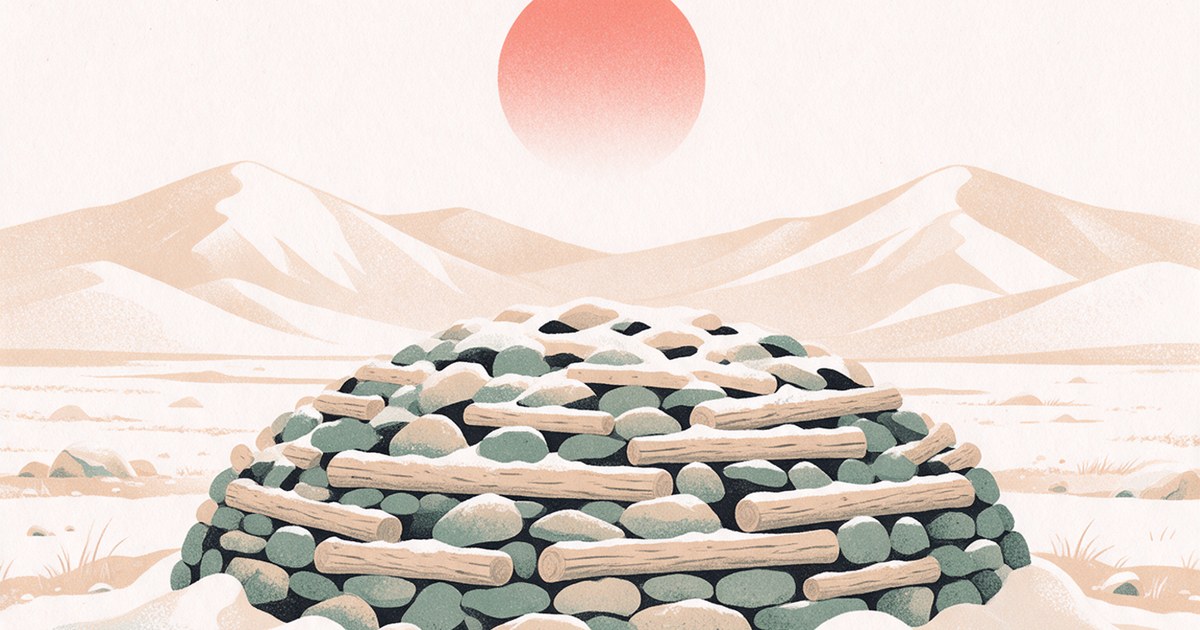
A burial mound in southern Siberia has lain frozen for almost three thousand years. Around the dead lay roughly a thousand hemp seeds, and hair from the grave carries chemical traces of compounds from hemp. The researchers behind the study call it the oldest directly dated evidence that people used the plant for its intoxicating effects. A Swedish archaeobotanist has worked on the find for seven years. Not everyone is convinced.
The grave in the Uyuk Valley
The mound is called Tunnug 1 and lies in the Uyuk Valley in the Republic of Tyva, in southern Siberia. It was built by the Scythians, the horse-riding people who spread across much of the Eurasian steppe, and is counted among the oldest known Scythian royal tombs. It measures about 140 metres across and hides a system of wooden burial chambers with bronze ornaments, beads, weapons and riding gear (ScienceAlert).
Excavation began in 2017, and the team lived in tents for months through seasons of swamps, snowstorms and frost (AP via PBS). What makes the site unusual is the ground. Frozen, waterlogged soil has protected not only the skeletons but also hair, skin, textiles and seeds, which after so long are normally gone (University of Gothenburg). The mound also holds the remains of dozens of sacrificed horses (New Scientist).
Around a thousand seeds, a single plant
The number of seeds differs between sources. The University of Bern gives roughly 1,000 (ScienceDaily), the University of Gothenburg more than 1,400. Six were radiocarbon dated, and together with other dating evidence they show the seeds were placed in the grave in the early eighth century BC.
The seeds lay around the skeletons. Archaeobotanist Natalia Riabogina of the University of Gothenburg points to the detail that makes the grave unique: hemp was the only plant the Scythians placed in this particular mound.
The seeds alone say nothing about how the plant was used. Hemp has been grown for oil and fibre for thousands of years, and seeds in a grave prove no intoxication. Their size and shape also suggest wild or wild-type plants rather than the varieties grown for oil and fibre, according to Riabogina.
What the hair shows
The decisive part comes from the hair. Using high-resolution mass spectrometry, the researchers found clear signals consistent with cannabinol, CBN, in several samples from the central burial chamber. CBN forms when THC oxidises. They also found weaker signals matching the mass of THC (ScienceDaily).
The analysis says nothing about how much was used or how. Smoke and ingestion are both possible. The study was published in Science on 5 November by a team from Germany, Russia, Sweden and Switzerland.
If the interpretation holds, it pushes the line back by about 300 years. The oldest firm evidence until now was chemical traces on wooden braziers in China, around 2,500 years old.
The criticism
Volker Auwärter, who heads forensic toxicology at the University Medical Center in Freiburg, calls the hair analysis scientifically weak. His objection is that the data do not distinguish between someone consuming hemp and the hair picking up traces from outside, by being buried together with the plant (AP via PBS). He says a forensic toxicology check would have been easy to arrange.
Elisa Guerra Doce of the University of Valladolid, who studies the use of mind-altering substances in European prehistory, sees it differently. She notes that toxicological hair analysis has been used in archaeology before, and says the study shows the plant was used and not merely deposited as a grave offering.
Lead author Gino Caspari of the University of Bern has also suggested hemp may have been used to sedate people chosen for sacrifice, since the mound contains scattered human bones. Archaeologist Adam Brumm of Griffith University calls the idea intriguing but highly speculative (New Scientist).
The Swedish part
Riabogina works at the Department of Historical Studies in Gothenburg and studies pollen and plant remains from excavations. In 2019 she contacted the archaeologists from Saint Petersburg digging in Tyva, and together they developed a method for collecting plant remains from the mound, slow work in which even very small plant parts have to be recovered. During the pandemic she guided the work remotely (University of Gothenburg).
According to Riabogina, studying hemp was never the plan. The find was unexpected. The group now wants to collect more material to understand how the plant was domesticated and what role it played in ancient rituals. Having both the seeds and the traces in the hair from the same grave makes it possible to compare the wild plant with the hemp grown for other purposes.