
On 27 February 2023 Deutsche Welle's anonymous source asked for one detail to be struck: that he had been in prison. The newsroom acknowledged the request the same day. Twenty-three days later Deutsche Welle published the detail, together with his former occupation, his agency and his city. A month after that it was all gone from the text again, removed in two stages, only one of which is marked for the reader.
This investigation rests on archived copies of the article that the reader can retrieve independently. Svenskhampa is owned and published by Daniel Johansson personally. He is himself affected by JuicyFields and, together with others affected and with the Swedish lawyer Lars J. Olofsson, pursues legal claims in the matter, and in 2023 he was copied on correspondence with Deutsche Welle in this matter. According to Danmarks Radio's own account, Olofsson is also the legal representative of the source this investigation concerns, and brokered the contact between him and the journalists. Danmarks Radio further states that a cooperation agreement existed between Olofsson and the source concerning those same private claims. The reader should weigh that. See Ownership and transparency.
The fraud has been investigated. JuicyFields took around €645 million from an estimated 186,000 investors before the platform collapsed in July 2022. That part of the story has been told.
This investigation concerns something else: what a newsroom wrote about its own protected source, and what it did with those words once they were published.
The article
The piece carries the headline «Немецкий принц, известный связями в РФ, оказался фейковым?», roughly "The German prince known for his Russian connections turned out to be fake?". It is written by Eugen Theise and was published on 22 March 2023 by Deutsche Welle's Russian-language service. It remains published.
The article concerns "Prince Jörg" Wolfgang von Sachsen-Coburg und Gotha, in reality Jörg Merz, and his role in JuicyFields AG, the fraud Europol has put at 645 million euros. It cites the prosecution authorities in Zurich and Berlin, and gives 761 complaints and just under nine million euros according to the Landeskriminalamt in Berlin.
To reach what happened inside the scheme, the newsroom had spoken to a Russian who by his own account had held a function equivalent to head of internal security at JuicyFields. He did not want to appear under his own name. In the text he is called "Anders".
His name is Igor Kekshin. He can be named here for a reason that did not exist in March 2023: he came forward himself more than a year and a half later, as the central witness in Danmarks Radio's documentary Den russiske insider in November 2024, and was then also named in the consortium investigation that Correctiv published alongside it, where the name was inserted after publication. On 22 March 2023 he was nobody's public figure. He was an anonymised source in an article that described him by occupation, agency, city and a prison sentence served.
This investigation concerns how his anonymity was broken, not his person, and Svenskhampa makes no claim about his role beyond what those sources have already published.
How the same organisation did it a month earlier
A month before Theise's article, another part of Deutsche Welle was working with the same source, and did the opposite.
On 22 February 2023 Nicolas Martin of DW's economy desk wrote to the lawyer who had brokered the contact, with Andreas Becker copied in. The subject line was the eighth episode of the podcast Cannabis Cowboys. Attached was a document titled Anders, audio and info.
"we had some consultations yesterday. Considering Anders delicate situation, we have prepared a document with everything that is planned to publish in EP8 about him."
The desk had compiled everything intended for publication about the source and sent it in advance. The same email sets out their reasoning on what might expose him:
"This is the only detailed information in EP7 that reveals something about him, but on the other hand anybody could claim such a thing. In EP7 we will also tease that we have travelled close to the Russian border to meet a whistleblower, but also in this case - it could whoever."
And in closing:
"So let us know as soon as possible, if there are any uncertainties."
That is pre-publication review, documented by the people carrying it out. The journalists test each detail against whether it could single out one individual, and conclude that a self-description in the podcast is deniable and that a trailer about a trip towards the Russian border could apply to anyone.
Nor was the arrangement imposed from outside. It was Deutsche Welle's own journalist who proposed the encrypted messaging service the correspondence ran on, and who asked on 22 February: "Do you have a preferred (secured) email?"
How binding he considered the procedure is clear from how he put it himself, the day after sending the document:
"No comment from you means green light… 😉"
And later the same day, explicitly:
"just to be clear: Anders and you are ok with the info we'll mention in the podcast, and also with the audio clips we sent you, right?"
What was at stake was equally clear. The lawyer had written it plainly two days earlier:
"Its his life that are on stake here, and we all need to have that in mind."
Twenty-nine days later the same broadcaster published his occupation, his agency, his city and his prison sentence.
The refusal, and what became of it
The pre-publication review was not a formality. It produced a concrete objection, and the objection concerned the very detail that was later published.
On 27 February 2023, five days after the email above, the lawyer relayed on Signal what the source had replied, verbatim and in quotation:
"I would like you to delete my following phrases in 5 minutes: \ I will always find everyone and everywhere.\ And the phrase \ caught corrupt officials, was in prison\"
Two formulations, then, that the source wanted removed from the podcast episode, the second being that he had been in prison. Nicolas Martin replied the same day at 12:15:
"Okay. Great. We will see how we can work around it."
The episode aired on 2 March. The following day Nicolas Martin wrote:
"Hope Anders is fine. At least he knew what was coming!"
That was the entire point of the procedure. The source knew what was coming, because he had been allowed to read it in advance and to strike what he could not live with.
Twenty-three days after the refusal, the detail stood in Deutsche Welle's Russian-language article, in sharper form: that he had served a prison sentence on charges of extortion and kidnapping. That time he had been shown nothing in advance.
The request concerned a podcast episode and was addressed to the economy desk. The Russian-language service is a different desk, and nothing in the material shows that Eugen Theise knew of the correspondence. Svenskhampa does not claim that he did.
What is established is simpler, and it is enough: Deutsche Welle was told in writing to remove the detail about the prison sentence, the request was acknowledged by one of its journalists, and three weeks later the organisation published it. Deutsche Welle is Germany's state international broadcaster, funded from the federal budget and broadcasting in 32 language services. It is a publicly funded public-service organisation that speaks outward with one voice. That the objection lodged with one desk and the publication came from another is not the source's problem. It is Deutsche Welle's.
What the first version said
This is how the newsroom described its source when the article was published:
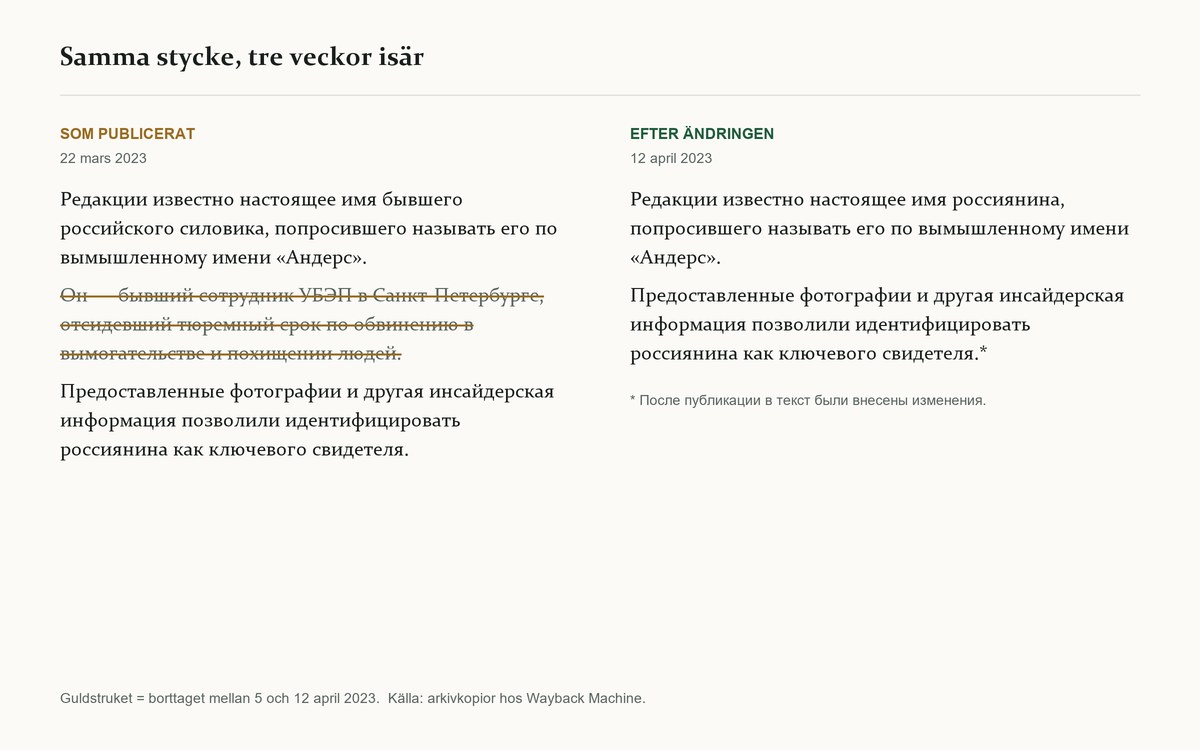
Редакции известно настоящее имя бывшего российского силовика, попросившего называть его по вымышленному имени "Андерс". Он - бывший сотрудник УБЭП в Санкт-Петербурге, отсидевший тюремный срок по обвинению в вымогательстве и похищении людей. Предоставленные фотографии и другая инсайдерская информация позволили идентифицировать россиянина как ключевого свидетеля.
In translation: the newsroom knows the real name of the former Russian security-services officer who asked to be called by the invented name "Anders". He is a former employee of UBEP in St Petersburg who served a prison sentence on charges of extortion and kidnapping. Photographs and other insider information provided made it possible to identify the Russian as a key witness.
Three details about an anonymous source therefore sit in the same passage: that he came from the security apparatus, at which agency and in which city he served, and that he had been imprisoned for two named categories of offence.
The accuracy of the details is not the question here. The question is that they stood there, and what they stood next to.
Kekshin's name already appeared in public registers, and a website devoted to attacking him had existed. What was not known, and what no register could reveal, was that he was the newsroom's source. That is what the article disclosed. The passage opens by stating that the newsroom knows his real name, and continues with occupation, agency, city and prison sentence. For anyone who knew which person in the organisation fitted that description, nothing was left to guess.
The description did not have to be complete to work. It only had to be precise enough for those who already knew who had worked in the organisation's security function. That circle was small. It was also the circle he had talked about.
The passage was still present in the archived copy of 5 April 2023, fourteen days after publication. The article carried no note at that point that anything had been changed.
What happened on 6 April
Fifteen days after publication the details acquired a name, and it did not happen at Deutsche Welle.
On the evening of 6 April 2023 the source was identified in JuicyFields' own official English-language Telegram channel, an open channel with tens of thousands of members. The sequence is preserved in the channel's own history, with timestamps, and it began with the article.
At 20:16 a user posting under the letter M put up the link to the article of 22 March. Fifteen minutes later, at 20:31, came a link to the UK companies register, with the words that the company "is owned by gmbh and has a Russian director". At 20:38 the article link went up again. Two minutes after that the same user wrote:
"There is a mention of a person who is your whistle-blower in the DW article. Follow the crumbles. You are very good at research and collecting info, however you lack some accuracy"
That is the only occurrence of the phrase in the material Svenskhampa has reviewed, nine Telegram groups and just over 34,000 messages.
This is where it becomes clear why the two things are not interchangeable. A register can supply a name. Nothing in a companies register can reveal that a person has spoken to journalists. That information was in the article of 22 March, which described the newsroom's source by former profession, agency, city and a served prison sentence, and it is there the user points when he writes that the mention is in it and tells readers to follow the traces.
The register entry he linked to was the late filing for JUICY HIGH LTD, submitted that same day, recording an appointment date almost two years earlier.
Svenskhampa does not know who M is and makes no claim about it. Nor is it claimed that Deutsche Welle intended anything. What is documented is the order and the direction: first the profile on 22 March, then the pointer to it, and fifteen days in between.
The same evening the identification was carried into the group in which the source himself took part. The exchanges below are published with the written consent of Kekshin and Lars J. Olofsson. His first reaction concerned the register entry:
"Am I now a director in an English company? )))"
>
"I have never been to England"
A week later, on 13 April, he wrote in the same group:
"yesterday after reading an article by DW where they made adjustments, tonight I slept well for the first time in the last year"
That is the only human reaction to the removal that survives, and it came the day after it was made.
What DW knew in April
The complaints reached the newsroom before the lawyer himself approached management. On 11 April 2023 at 11:08, Nicolas Martin wrote again:
"I just came from my Easter vacation and in my inbox I have received some complaints about the JuicyFields article in Russian. The complaints were sent from your clients and Marguerite Arnold."
"The article has been edited by our Russian department and they have done their due diligence and risk assessment based on their research. Therefore I need to know from Anders if he is uncomfortable with the information provided in the article? If this is the case I would approach them as soon as possible."
Two things follow from those lines, and both come from Deutsche Welle.
The Russian desk had, according to Martin, carried out its own risk assessment. And on 11 April, twenty days after publication, the question of whether the source himself was uncomfortable with the details had still not been put to him. It would now be put, by a journalist on a different desk, who offered to approach his colleagues afterwards.
A risk assessment that does not include the person whose risk it is, is an assessment of something else.
The first removal
At some point in the week that followed, the details disappeared from the text.
In the archived copy of 12 April 2023 the same paragraph reads:
Редакции известно настоящее имя россиянина, попросившего называть его по вымышленному имени "Андерс". Предоставленные фотографии и другая инсайдерская информация позволили идентифицировать россиянина как ключевого свидетеля.\*
"The former Russian security-services officer" has become "the Russian". The sentence about UBEP, St Petersburg and the prison sentence has been struck in its entirety. At the foot of the article a note has appeared:
\*После публикации в текст были внесены изменения.
"After publication, changes were made to the text." The asterisk sits on the sentence that was altered. Deutsche Welle has therefore marked the intervention, which is more than many newsrooms do.
The second removal, which is not marked
This is where what was previously known about the matter ends, and where a comparison of the copies begins.
The removal on 12 April was not complete. Further down the same text, in the section where the source is quoted on where the money went, this still stood:
...рассказал бывший УБЭПовец из Санкт-Петербурга.
"...said the former UBEP man from St Petersburg." The agency and the city therefore remained in the article after the same details had been removed higher up, and after the note about the change had been added.
In the archived copy of 21 April 2023 that wording has been replaced with «Андерс» alone. No new footnote has been added. The single asterisk in the article remains where it was, on the first change.
It looks like a line overlooked in the first pass and corrected in the second. That the second correction was given no note of its own is a smaller matter than the first, but it means the article's change marking does not cover everything that was changed.
That is how the text still reads today.
| Version | "former security-services officer" | UBEP + St Petersburg (upper) | Prison sentence | UBEP + St Petersburg (lower) | Footnote |
|---|---|---|---|---|---|
| 22 March 2023 | yes | yes | yes | yes | no |
| 5 April 2023 | yes | yes | yes | yes | no |
| 12 April 2023 | no | no | no | yes | yes |
| 21 April 2023 | no | no | no | no | yes (unchanged) |
| 14 August 2026 | no | no | no | no | yes (unchanged) |
What the time windows permit, and what they do not
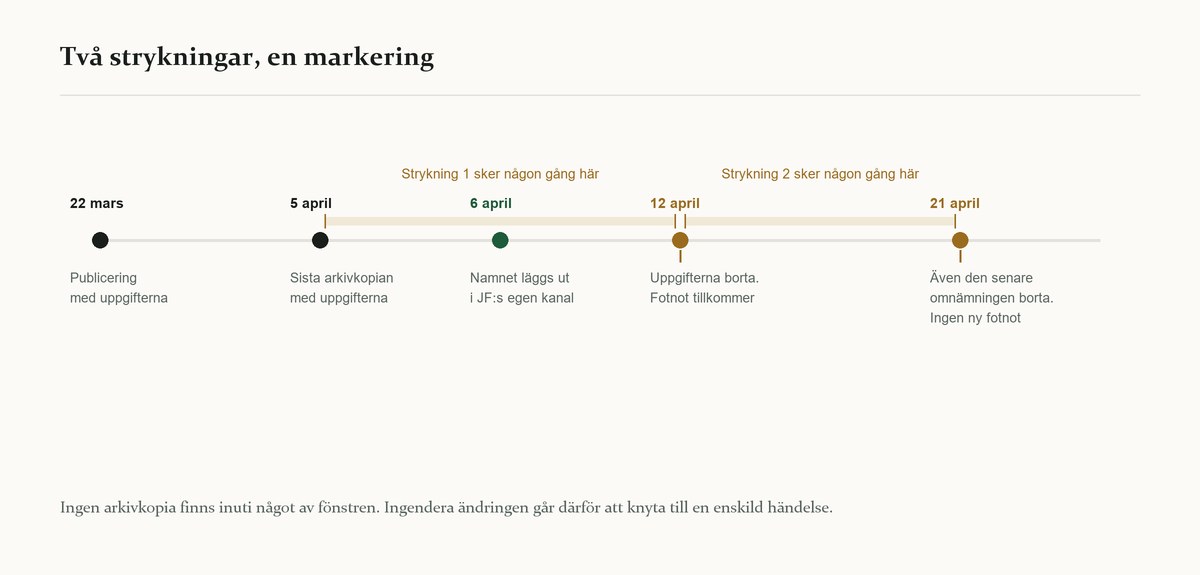
The Wayback Machine holds 33 archived copies of the article between 22 March 2023 and 10 March 2024. Two gaps are decisive, and neither can be filled.
The first change occurred at some point between 5 April at 19:51 and 12 April at 11:59, both times UTC. The second occurred between 12 April at 11:59 and 21 April at 15:30. There is no archived copy inside either window, and the article's short link `p.dw.com/p/4Ofpw` has no captures of its own that fill them.
That means neither change can be tied to any particular event or request. Svenskhampa makes no such claim. What is established is the chronology: the details stood published for at least fourteen days, were removed in two stages during April, and only the first stage is marked for the reader.
Why the difference between the two matters
A correction that is marked is a correction the reader can see. The note of 12 April says the text has been changed, and the asterisk shows where. Anyone reading the article today knows that something happened to that particular sentence.
The second change carries no such marker. A reader who today sees «Андерс» further down the text has no reason to believe anything else once stood there. That the article carries a change note higher up makes it harder, not easier, to understand that the note does not cover everything that was changed.
It says something about the result: the published text documents its own intervention only by half.
Two more newsrooms, and the same man
A year and a half later two other newsrooms wrote about the same person, and both decided the opposite way from Deutsche Welle. The comparison is instructive, not because it convicts anyone, but because it shows what is customary.
On 8 November 2024 CORRECTIV published the consortium's investigation together with Danmarks Radio, Der Spiegel, Paper Trail Media, ZDF, BNNVARA, der Standard and Svenska Dagbladet. In that version the name Kekshin does not appear once. The account of the refusal was already there, but the source was anonymous.
At some point between 8 and 12 November the name was inserted. In the version of 12 November it appears fifteen times. The newsroom set out what it had done:
«Die Aussagen des Aussteigers Igor Kekshin sowie dessen richtiger Name wurden nachträglich eingefügt.»
The note in its current wording records three further changes, among them that the full name of one of the counts was removed after he applied for an interim injunction at the Landgericht Frankfurt.
Two days after the original publication Danmarks Radio named him openly in its documentary, and published the same day a separate text in which two editorial heads answer five questions about how the material was handled: the source's motive, his credibility, the basis for calling the principals the Russian mafia, the role of the Swedish lawyer, and why a third company is named although knowledge of the fraud could not be shown. On credibility they write that every statement the source makes in the documentary has been tested and confirmed through extensive research and conversations with a large number of sources.
Set side by side, the decisions look like this. Deutsche Welle described an anonymous source by former profession, agency, city and prison sentence, removed the details in two stages and marked one of them. CORRECTIV published without the name, inserted it within four days and marked the addition. Danmarks Radio named him openly and accounted for its reasoning in a separate text.
There is a difference that belongs here, and it counts in the later two newsrooms' favour. By November 2024 Kekshin had come forward himself, given interviews and appeared in his own words. Naming a cooperating source with his knowledge is not the same as describing an anonymous one in terms that make him recognisable. The point is not that anyone else got it wrong.
But the order of those two things belongs in the account. Kekshin did not step out from behind a protection he still had. By the time he appeared under his own name in November 2024, the profile of him had been published a year and a half earlier, and he had been pointed out in JuicyFields' own channel as the newsroom's source, with an explicit reference to that same article. The same evening the identification was carried into the group where he took part himself, so he knew about it. The anonymity was spent before he chose to appear openly, and it was not he who spent it.
That matters for how his later appearances should be read. A source appearing under his own name after being exposed is not evidence that the exposure did no harm. It is what is left to do once the thing the protection existed for is already gone.
The next step Svenskhampa can account for from its own knowledge, and does so openly. Kekshin appearing under his own name was his own decision. It was taken on the advice of his counsel Lars J. Olofsson and of the undersigned, and that advice was given because no other route remained. Once the profile had stood published and the name had been posted in the fraud's own channel, there was no anonymity left to manage. What remained was the reverse: being visible enough that an attack would be costly to whoever carried it out, and placing the material with newsrooms that could carry it further. Publicity had to do what source protection no longer could.
The reader should weigh that against the fact that the undersigned is a party to the matter. It stands here because it is decisive for how the article's central question should be understood, and unlike everything else in this text it cannot be tested against an archived copy. Anyone wishing to test it may do so against what actually happened next.
The comparison therefore comes down to this: of three newsrooms writing about the same man, one left a change unmarked, and it was also the only one that gave no account of its reasoning at all.
What the source was worth
Kekshin was no disinterested bystander, and Svenskhampa does not present him as one. He had himself held a senior function in what he described, and he had broken with the organisation after an internal dispute over money. That a source has motives of his own is common and rarely pretty. It does not suspend source protection. Sources like that are what the protection exists for.
Nor is motive the same as result. What he handed over led somewhere. Europol's Operation Stoner ended in nine arrests in April 2024, he became the central witness in Danmarks Radio's documentary, the consortium published in November that year, and the man named as the ringleader has been extradited to Spain, where the case against him is under way. Almost 186,000 people affected have a route to redress that did not exist before.
The material also moved the question away from ordinary financial crime. The consortium's reporting described the fraud as part of Russian hybrid warfare, with a German prosecutor on record that the upper level can be attributed to the Russian mafia, and with the man named as second in command linked to a drone factory outside St Petersburg whose website carried the insignia of the Russian Defence Ministry.
That is what a source from the inside was worth. It is also the measure of what an exposure costs, and what the next person will weigh when he considers speaking.
Why the procedure exists
Reviewing in advance what will be said about an anonymous source is not a courtesy. It exists because for seventy years newsrooms have been among the most sought-after places to stand for anyone who wants access to information about others.
In its final report of April 1976, the US Senate's Church Committee recorded that until February that year the CIA had maintained covert relationships with about fifty American journalists or employees of US media organisations, and that these formed part of a network of several hundred foreign individuals. Through them the agency had direct access to, in the report's own words, a large number of foreign newspapers and periodicals, scores of press services and news agencies, radio and television stations and book publishers. The report also notes that more than a dozen United States news organisations had served as cover for agents abroad, and that a few of them did not know it.
The reform that same year prohibited paid relationships with accredited correspondents. In the same breath the committee recorded that fewer than half of the relationships would end, because the prohibition did not cover freelancers and unaccredited staff.
On the other side the pattern was the same. The KGB general Oleg Kalugin has described journalistic cover in his memoirs as the most convenient of all: it gives legitimate access to sources, admission to events and freedom of movement without arousing suspicion.
None of this says anything about Deutsche Welle, and Svenskhampa asserts nothing about either the newsroom or the journalist who wrote the article. It says something about why the profession developed the procedures it has. A newsroom taking on a source from inside an organisation linked to a foreign state's interests works in a landscape where information about who is talking is valuable to people other than readers. That is precisely the insight behind the procedure the economy desk applied in February.
And it makes the question sharper, not softer: the procedure existed, it was known within the organisation, and it was applied by one desk and not by another.
What exposure means in this case
Source protection is an abstraction until you know what happens to those who are pointed out.
In this case we do know, and not from the accounts of those affected but from the journalistic consortium that investigated the fraud. Danmarks Radio reported in November 2024 that the former JuicyFields director Willem van der Merwe had been threatened in Russian that his wife and daughter would be raped, that his home in Italy had been attacked with petrol bombs, and that another former director's car was burned in Germany.
The same newsroom describes the precautions required to meet Kekshin at all: a security company placed personnel at checkpoints around the meeting place.
This is not a theoretical risk, then. It is the environment an anonymous source in this matter was in, described by the newsroom that interviewed him.
What later happened to Kekshin himself lies largely outside this investigation. The consortium reports one account: that since his testimony he has been hunted, that his car was blown up and his dogs poisoned. It stands in the subjunctive and with the words «he says», rendered as his own account rather than as established fact. Further accounts circulate, but they are not documented by police reports or contemporaneous reporting, and are therefore not published here.
Nor are they needed. The point stands without them: on 22 March 2023 an article went out stating that the anonymous source was a former security official from St Petersburg with a served prison sentence, in a matter where others involved had had their homes firebombed.
Which desk wrote it
The article did not come from Deutsche Welle's investigative desk. It was published by the Russian-language service, a different desk within the same organisation. That follows from the article's own byline and from where it sits on dw.com.
The difference matters. It was the podcast desk that in February set out in advance everything that was to be said about the source and invited objections. On 22 March a different desk in the same organisation published his former profession, his agency, his city and his served prison sentence.
Svenskhampa has asked Deutsche Welle whether the organisation applies a common source-protection standard across its language services, and whether any equivalent procedure preceded publication on 22 March. The question formed part of the request for comment and was not answered within the deadline.
A journalist at Deutsche Welle described the matter to Svenskhampa on 19 September 2023. The person is not named:
«I'm not familiar with the security procedures the two journalists followed as I wasn't working from Berlin at the time and didn't hear much about their production process, but to be upfront with you as too, not many people in dw are familiar with the security standards investigative journalism entails. The investigative unit where I work is the only desk that has a different approach to this and is the most strict on this matter (ie we use other channels to communicate).»
And then:
«And this is absolutely no excuse. Giving away a whistleblower identity and putting their life at risk is unacceptable.»
The account is one member of staff's and not Deutsche Welle's answer. But it comes from inside the organisation, and it describes the same state of affairs the February correspondence shows: that the procedure existed on one desk and was not common property across the organisation.
What the newsroom was doing at the same time
One more thing belongs here, in fairness, even though it cuts against the simple version of the story.
During the same weeks Deutsche Welle was scrutinising the lawyer who had brokered the source. On 28 March 2023, six days after the article, Andreas Becker, senior editor on the economy desk, wrote explaining why:
"we felt it was our journalistic duty to ask you about some documents about your past that are being circulated (we do not know by whom, although we know our sources)"
"Since you told us you have decades of experience in this area, but none of that can be found online, we think it's defensible for us to ask you for details."
That is a reasonable position. A newsroom receiving material from an interested party should test that party, and failing to would have been worse journalism.
It also says something about the landscape this played out in. Documents about the lawyer's past were circulating, spread by parties Becker does not name. The same had happened the month before to the German journalist who had written critically about JuicyFields, according to the correspondence.
But testing a party does not affect the duty owed to a source. The two questions are separate, and Deutsche Welle treated them as separate: the scrutiny of the lawyer was conducted by letter, with questions and an opportunity to answer, which is precisely the procedure that was not applied before the details about the source were published.
The details survive elsewhere
A removal in the original does not reach the copies already made. During April 2023 the article's content was republished by other Russian-language sites. Svenskhampa has not been able to establish which versions those copies rest on and therefore does not list them here, but the question is one of principle and not hypothetical: a newsroom that writes identifying details about its own protected source can remove them from its own text, and from its own text only.
That is also where this investigation lands, and not in any claim about intent.
Nothing in the material suggests that anyone wanted to expose the source. The desk that prepared the podcast episode chose encrypted communication, asked for a secured email address, compiled in advance everything that was to be said, and invited objections. The journalist closest to the source wrote himself that he hoped all was well, and that the source had at least known what was coming.
How the details then travelled to another desk, Svenskhampa does not know and does not claim to know. That they did is established. What is documented after that is how the organisation handled it once it became known: on 11 April a journalist on the economy desk asked whether the source was uncomfortable with what had been published, three weeks after publication. On 14 April an editor requested the entire correspondence. By 21 April nobody had replied.
The source had an understanding with Deutsche Welle. Not with the economy desk, not with two individual journalists, but with the broadcaster. It was also Deutsche Welle that published the details, and Deutsche Welle that did not reply when the matter was put to its management.
A source cannot choose which part of a broadcaster gets to know who he is. He hands his information to two journalists and has to trust that the promise travels with it through the whole organisation. If it does not, he has no promise. He has a conversation with two people, and everyone else is free to write what they like.
Right of reply
Deutsche Welle was put the details in writing on 16 August 2026: that on publication the article described an anonymous source by former occupation, agency of service, city and a prison sentence served; that these details were removed in two stages between 5 and 21 April 2023; that only the first stage is marked with a footnote; together with the question of why the second is not, and whether the newsroom took any steps regarding the republications made while the details stood. The request was addressed to the newsroom, not to any individual member of staff.
The same day Eugen Theise, who wrote the article of 22 March 2023, was put the matters concerning that text and the changes made to it. Nicolas Martin and Andreas Becker of the economy desk were put the matters concerning how the same source was handled a month earlier.
Those letters carried a reply address that could not receive the replies. Svenskhampa's address `info@svenskhampa.se` had no MX record in the domain's zone between 28 May and 28 August 2026, and mail that did reach the server was refused with `554 5.7.1 Relay access denied`. A reply sent during that period had nowhere to arrive. The fault was ours and no one else's, and nothing should be read into the first request going unanswered.
The address was repaired on 28 August 2026 and tested. All requests were reissued on 2 September, to the same recipients and with the same particulars, with a new deadline of 9 September 2026 at 12:00. The deadline expired without a reply.
A reply will be accepted and published after the date of publication.
About this text
The article was first published on 24 August 2026 and taken down four days later, on 28 August. The reason was that it stated Deutsche Welle had not replied, while the route for a reply to reach us had been broken throughout. That statement could not be sustained. The text is republished here with the sequence set out above and with its original publication date retained. Part 1 of the series was unaffected and has remained in place.
Sources
- Eugen Theise, «Немецкий принц, известный связями в РФ, оказался фейковым?», Deutsche Welle (Russian-language service), 22 March 2023: dw.com, short link p.dw.com/p/4Ofpw
- Archived copy of 22 March 2023, the day of publication: web.archive.org
- Archived copy of 5 April 2023, last known version carrying the details: web.archive.org
- Archived copy of 12 April 2023, first known version without them, carrying the footnote, and with the UBEP reference still present further down: web.archive.org
- Archived copy of 21 April 2023, first known version in which the later reference is gone as well: web.archive.org
- The Wayback Machine's full record of archived copies of the URL: web.archive.org
- CORRECTIV and others, «Gier, Mordaufträge und der russische Geheimdienst», 8 November 2024: correctiv.org
- Archived copy of 8 November 2024, the day of publication, without the name: web.archive.org
- Archived copy of 12 November 2024, carrying the name and the note recording the insertion: web.archive.org
- Casper Walbum Høst and Mikala Krogh, «Fem svar på spørgsmål om 'Den russiske insider'», Danmarks Radio, 10 November 2024: dr.dk
- Correspondence between Deutsche Welle's economy desk, through Nicolas Martin and Andreas Becker, and Lars J. Olofsson, February to April 2023, by email and Signal. Editorial archive.
- JuicyFields' official English-language Telegram channel on 6 April 2023, and the group in which the source himself took part on 6 and 13 April 2023. Editorial archive. The source's words are published with his and Olofsson's written consent.
- Message from a journalist at Deutsche Welle, 19 September 2023. Editorial archive. The journalist is not named.
Byte-identical copies of all four versions, retrieved with the Wayback Machine's `id_` modifier and therefore without the archive's own frame, together with the live page retrieved on 14 August 2026, are held in the editorial archive.
This is the second part in a series on how established media came to be used in the JuicyFields case.