
There is a signalling system in the body that most people have never heard
of, even though it sits in every vertebrate and regulates most of what has
to do with balance. It is called the endocannabinoid system, and over the
past fifteen years one of the most consistent findings in stress research
has been that prolonged stress alters it.
This is a review of what has actually been shown — and an equally careful
account of where the research runs out.
A system built on demand
The endocannabinoid system consists of receptors, the body’s own signalling
molecules, and the enzymes that build and break them down. The receptors
were mapped during the 1990s: CB1 was described in 1990, CB2 in 1993. The
first endogenous signalling molecule — anandamide — was identified in 1992,
named after the Sanskrit word for bliss.
One detail makes the system unusual. Most signalling substances are
manufactured in advance and stored in vesicles until needed. Anandamide is
not. It is built on demand, directly from the fatty acids of the cell
membrane, at the moment it is required, and broken down shortly afterwards
by the enzyme FAAH.
This is therefore not a system designed to maintain a level. It is designed
to respond to a situation — and that is precisely why sustained load can hit
it so hard.
What stress does: the mechanism, step by step
The relationship between stress and endocannabinoids is today among the best
mapped in the field. In short: stress lowers anandamide levels, and chronic
stress produces a downregulation of CB1 receptors in virtually every brain
region examined.
What makes it interesting is that the mechanism is known in detail, not
merely as a correlation. In a study published in
the Journal of Neuroscience in 2015,
Gray and colleagues showed how it works:
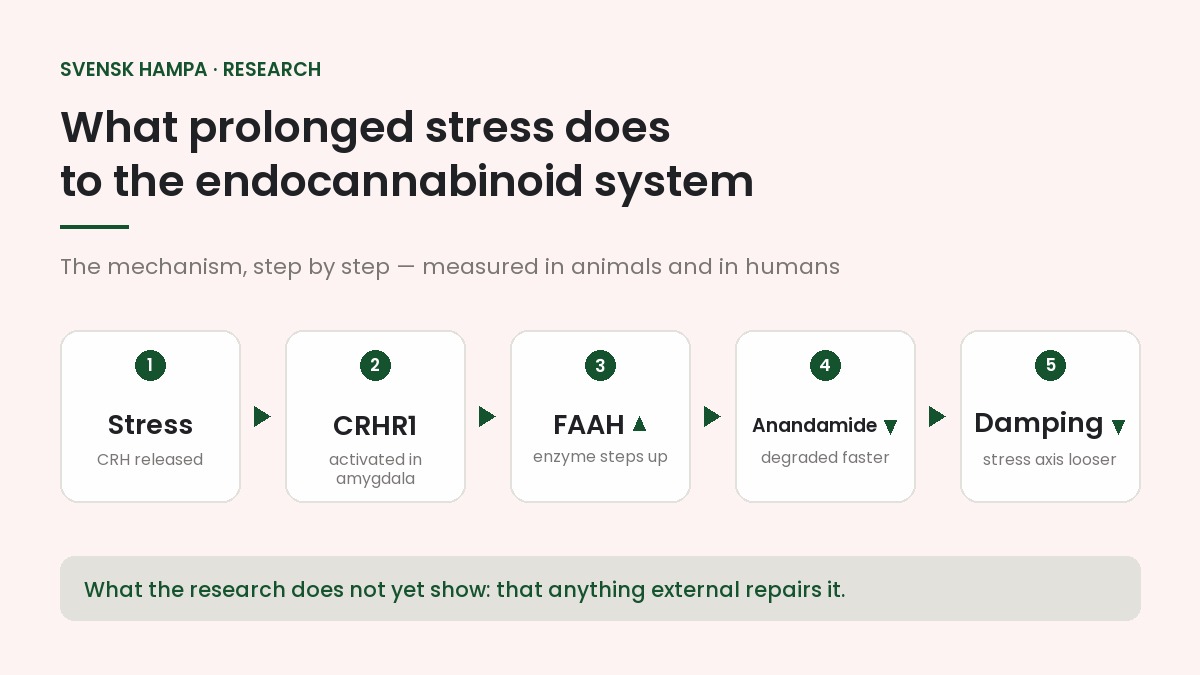
1. Stress releases CRH — corticotropin-releasing hormone.
2. CRH activates the CRHR1 receptor in the amygdala.
3. CRHR1 activation produces a rapid increase in FAAH activity — the
same enzyme that breaks down anandamide.
4. Anandamide levels in the amygdala fall.
5. The inhibitory tone anandamide normally exerts weakens, the HPA axis is
activated more readily, and anxiety behaviour increases.
The researchers also showed the reverse: when FAAH was blocked, the effect
did not occur. This is therefore not a consequence of stress in general, but
a specific enzymatic event.
The field as a whole is summarised by Morena, Patel, Bains and Hill in
Neuropsychopharmacology in 2016,
a review that remains the standard reference.
And it is not only animal models
The objection to all of the above writes itself: these are rats and mice.
But there is human data, and it points the same way.
In a PET study published in
Neumeister and colleagues examined 25 untreated individuals with
post-traumatic stress disorder, 12 trauma-exposed controls and 23 healthy
controls. Participants underwent magnetic resonance imaging and a PET scan
with the radiotracer [11C]OMAR, which binds to the CB1 receptor.
The result:
- The PTSD group had more CB1 receptors in the brain regions that handle
fear and anxiety
- The PTSD group simultaneously had lower levels of anandamide
- The three measures together — CB1 binding, anandamide and cortisol —
classified around 85 per cent of cases correctly
This is the picture of a system that has turned up its reception because the
signal is failing. Precisely what one would expect of a receptor that has
had too little to respond to over a long period.
Why it matters beyond PTSD research
PTSD is an extreme, and nothing here should be read as suggesting that
ordinary working stress is the same thing. But the mechanism described —
CRH, FAAH, anandamide — is not diagnosis-specific. It is the body’s general
stress machinery, and that connection is the whole point: sustained
vigilance is not a feeling, it is a biochemical state that can be measured.
It also gives physiological grounding to a hypothesis long discussed at the
margins of the field. Ethan Russo proposed in 2004, and reconsidered in
2016, that an underperforming endocannabinoid system may lie behind
conditions that lack clear findings but share features — migraine,
fibromyalgia, irritable bowel. He called it clinical endocannabinoid
deficiency. The hypothesis has been criticised as difficult to test. Stress
research gives it at least a credible way in: here is a documented mechanism
by which such a deficit could arise.
Where the research runs out
Here the text must change register, because it is at the next step that most
articles on the subject go off the rails.
Nothing above shows that anything external repairs this.
What exists is two separate observations pointing towards one another:
The first: prolonged stress lowers the body’s anandamide, via a known
enzymatic mechanism, measurably in both animal models and humans.
The second: in a clinical study by Leweke and colleagues, published in
Translational Psychiatry in 2012,
in which cannabidiol was compared with the antipsychotic drug amisulpride,
serum levels of anandamide rose significantly in the CBD group — and the
increase correlated with clinical improvement. The researchers proposed that
CBD slows the breakdown of anandamide rather than replacing it.
The conclusion that lies nearest to hand, that the one should therefore
remedy the other, has not been tested clinically by anyone. Leweke’s
study concerned schizophrenia, not stress. It was small. The mechanism is
disputed — some researchers hold that the effect runs via binding proteins
rather than FAAH inhibition.
That two findings point towards one another is not a third finding. It is a
hypothesis waiting for someone to test it.
Why the gap exists
It is worth a closing reflection that the question is so obvious and yet
untested.
Part of the explanation is structural. Cannabis was placed in 1961 in the
strictest category of the UN convention and in 1970 in Schedule I in the
United States — a category defined as having no accepted medical use.
Research required not only a licence but raw material from a single
federally licensed cultivation. That monopoly was not broken until 2021.
Most of the controlled human studies on cannabidiol have been published
since 2010.
The field is therefore not thoroughly investigated and awaiting summary. It
is young. And this question — what happens to a stress-depleted
endocannabinoid system if one supplies something that slows the breakdown of
anandamide — is among the more immediate ones still without an answer.
—
Sources
- Gray JM, Vecchiarelli HA, Morena M et al. (2015). “Corticotropin-Releasing
Hormone Drives Anandamide Hydrolysis in the Amygdala to Promote Anxiety.”
Journal of Neuroscience 35(9):3879–3892.
- Morena M, Patel S, Bains JS, Hill MN (2016). “Neurobiological Interactions
Between Stress and the Endocannabinoid System.” Neuropsychopharmacology
41(1):80–102.
- Neumeister A, Normandin MD, Pietrzak RH et al. (2013). “Elevated brain
cannabinoid CB1 receptor availability in post-traumatic stress disorder:
a positron emission tomography study.” Molecular Psychiatry 18:1034–1040.
- Leweke FM, Piomelli D, Pahlisch F et al. (2012). “Cannabidiol enhances
anandamide signaling and alleviates psychotic symptoms of schizophrenia.”
Translational Psychiatry 2:e94.
- Russo EB (2016). “Clinical Endocannabinoid Deficiency Reconsidered.”
Cannabis and Cannabinoid Research 1(1):154–165.
*This article describes published research on the body’s own endocannabinoid
system. It does not constitute medical advice and makes no claims about
health effects of cannabidiol or any other product.*