In 2022 a US state regulator found that King Kong Organics and Edouard Joseph had sold unqualified securities and made statements the Commissioner found untrue in a material respect. Three and a half years later he appears on CNBC Africa as chief executive of KKOG Global, a company whose website states an active licence in five African countries.
Investigations are built on regulatory decisions, public registers and documents readers can verify themselves.
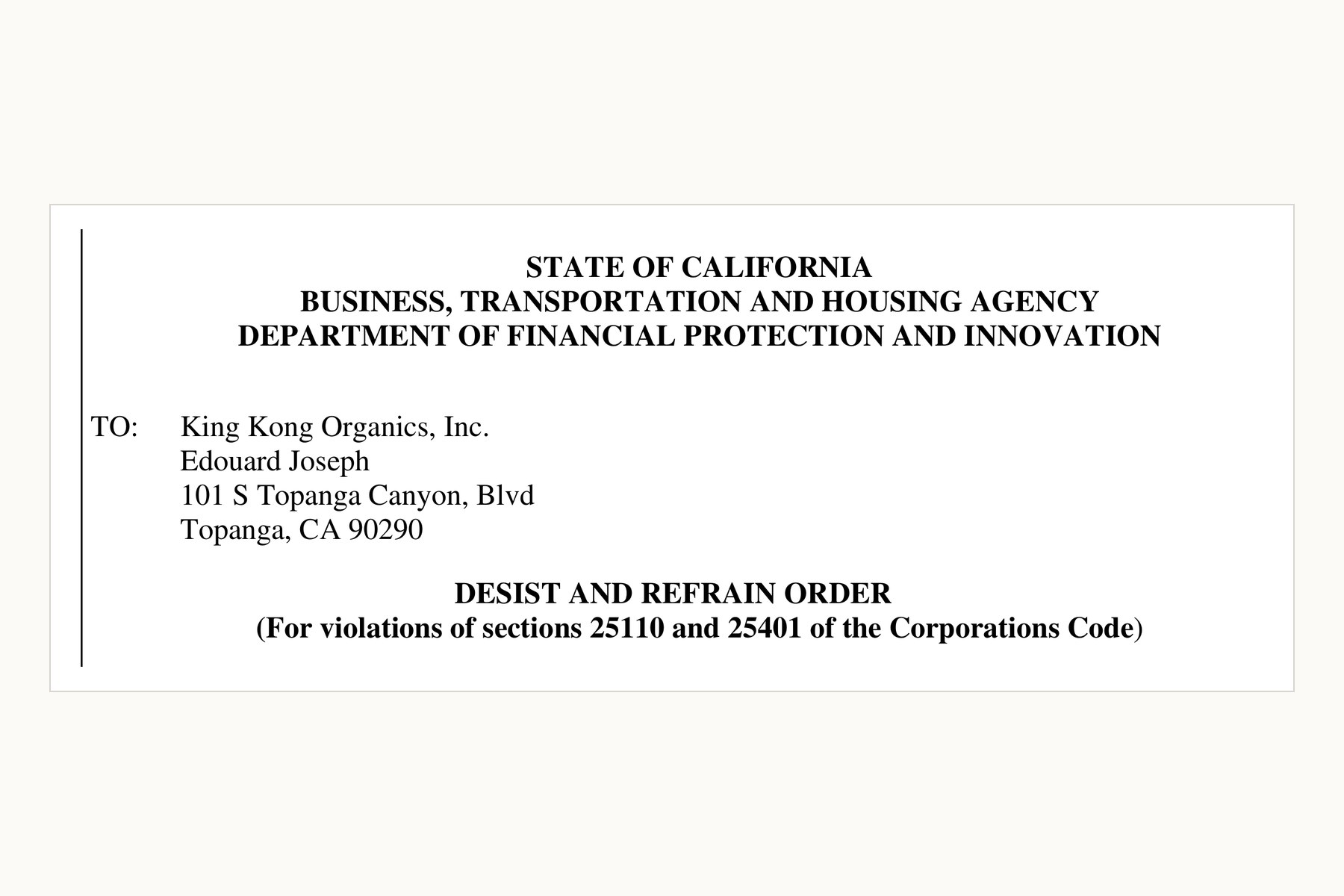
On 24 August 2022 the California Department of Financial Protection and Innovation issued a desist and refrain order against King Kong Organics, Inc. and against Edouard Joseph personally. The order remains published on the regulator's own website. It runs to three pages, and it is unusually specific about what was sold and how.

What was sold
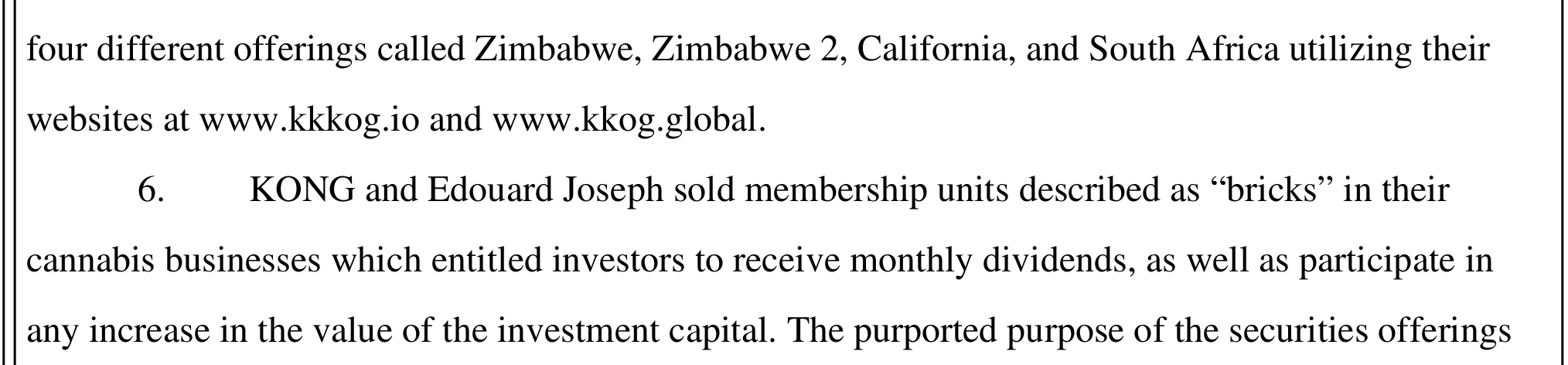
From on or about 20 July 2018 the company offered and sold securities in the form of investment contracts, through general solicitation on two websites. The order names them: www.kkkog.io and www.kkog.global. The order describes Joseph as the company's managing member and records that he represented himself as "Founder and Executive Chairman".
The units were called bricks. Buyers were to receive monthly dividends and, in addition, a share in any increase in the value of the invested capital.
There were four offerings. They had names: Zimbabwe, Zimbabwe 2, California and South Africa.
The marketing is still online. Five videos remain publicly available on the company's and Joseph's own YouTube channels, uploaded between November 2018 and October 2019, among them the one below, showing the greenhouses investors were buying units in.
"KKOG Greenhouse Grows", published on the Rene Joseph channel on 5 November 2018, a little over three months after the offerings began.
The statement that was found untrue
The Commissioner found that the company and Joseph had made untrue statements of material fact. The one singled out concerns the ability to get out of the investment.
Investors had been told they could withdraw their money whenever they wished. In fact, the regulator records, investors repeatedly requested a refund and attempted to sell their units. Without success.

The order rests on two provisions of California's securities law: section 25110, on the sale of unqualified securities, and section 25401, on untrue statements made in connection with a sale. The company and Joseph were ordered to desist and refrain. In the order's own wording the prohibition is directed at the further sale of ownership interests in cannabis greenhouses. That is what the video above shows.
An order of this kind is an administrative decision. It is not a criminal conviction, and should not be read as one.
What followed
Nothing, as far as public sources show.
The regulator's own enforcement register lists a single matter against this respondent, the order of August 2022. The page was last updated in September 2024. No penalties, no revocations, no follow-up orders, no settlement.
Searches of the US court database CourtListener, carried out on 31 July 2026, return no results at all for the company. The name Edouard Joseph appears in fourteen matters, none of which can be connected to King Kong Organics or to the sales the order concerns. Svenskhampa has found no record of charges being brought. CourtListener's coverage of California state courts is limited, however, and the absence of results does not exclude proceedings at state level.
January 2026
On 20 January 2026 Edouard Rene Joseph appeared on CNBC Africa, in the segment "Biofuels reshaping Africa's energy future". He was introduced as chief executive of KKOG Global.
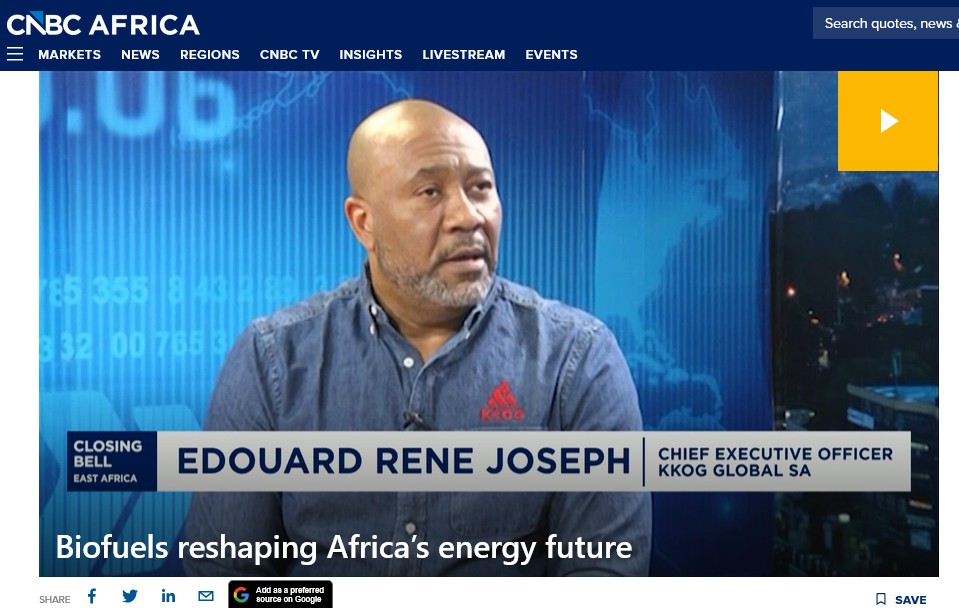
The conversation concerns biofuel. At 2 minutes 25 seconds he says:
"We have about 10,000 hectares. We're creating the biodiesel from hemp, which is the male cannabis plant."
Hemp is not the male plant. Hemp is a legal category, not a sex. Under the EU regulation on the common agricultural policy, an area counts as hemp cultivation only if the variety has a THC content not exceeding 0.3 per cent and is listed in the EU common catalogue of varieties. The line is drawn on the content.
Botanically, Cannabis sativa L. is normally dioecious: male and female flowers sit on separate plants. In a hemp field they therefore stand side by side. Breeders have in addition developed monoecious varieties, carrying both sexes on the same plant, the French and the Polish fibre varieties among them. The trait is not stable on its own, and has to be maintained through continuous selection during seed multiplication.
The presenter then asks what volumes are involved in Rwanda. The answer runs from 5 minutes 44 seconds to 6 minutes 10 seconds. The figure of 5,000 tonnes falls in its final sentence, at 6 minutes 3 seconds:
"We have only about five hectares. We're working with RDB to get an additional 35, or additional 30 hectares, and we'll be producing roughly about 20 litres of cannabis oil per day, and we'll be able to extract and package and export 5,000 tons per hectare."
The statement is internally inconsistent. Five hectares at 5,000 tonnes each is 25,000 tonnes of material through a facility said, in the same sentence, to produce 20 litres of oil a day.
Thomas Prade at the Swedish University of Agricultural Sciences in Alnarp has measured industrial hemp yields in Swedish field trials. Svenskhampa asked him what can actually be produced per hectare.
"Industrial hemp yields are usually between 5 tonnes of dry matter per hectare in Umeå and perhaps 12–15 tonnes of dry matter per hectare in Skåne," he replies. "Yields can then be higher with intensive fertilisation, and under good soil and water conditions."
(Prade answered in Swedish. The translation is Svenskhampa's.)
Prade adds a qualification that works in Joseph's favour. Measured as fresh weight rather than dry matter the numbers grow, around 100 tonnes per hectare is possible, corresponding to 20 tonnes of dry matter at a dry matter content of 20 per cent. A large number is therefore not unreasonable in itself. It depends on what is being weighed. But five hectares at 100 tonnes of fresh weight is 500 tonnes, not 25,000.
Put to him in writing, Joseph replies that the figure is "approximately 5,000 kilograms per hectare, not tonnes", a correction, by a factor of a thousand, of what he himself said on air. Svenskhampa has transcribed the segment and checked it against the audio. The word spoken in the broadcast is tons.
The corrected figure, 5 tonnes of dry matter per hectare, sits at the lower end of Prade's range, roughly what a field outside Umeå yields.

Prade did not know of the company's correction when he answered, and the company did not know of Prade's answer. Asked what the figure might have been meant to refer to, Prade nonetheless guessed at 5,000 kilograms of dry matter per hectare. It is the same figure the company gave in writing the same day.
A third figure is given at 4 minutes 38 seconds, on the yield of conversion to biofuel:
"The yield for soybeans is about 30 percent, and then they went to corn to use corn as a biomass product to create the biofuels … but that's about 37 percent yield, whereas cannabis is 97 percent."
What the figure refers to is not stated in the segment. One possible reading is harvest index, the share of above-ground biomass that can be put to use. For cereals it sits at around 50 per cent: the grain is harvested, the straw left in the field. For soy, 30 per cent corresponds to the beans. That nearly all above-ground biomass in hemp can be used is a recurring argument in the literature.
As a comparison between crops, that reading does not then hold all the way. Apply a biorefinery concept, where protein is extracted and the residues go to feed or biogas, and other crops can also exceed 90 per cent. Hemp's advantage lies in reaching the figure without further processing, not in other crops being incapable of it. What quantity the figure in the broadcast actually refers to, Svenskhampa has not been able to establish.
What the website says today
One of the two websites named in the 2022 order is still running. It is kkog.global.
kkog.global carries the heading "A cannabis network spanning 13 African Countries". Beneath it the countries are listed one by one, with a licence status given for each. The page states Active License for Zimbabwe (cultivation and extraction), Malawi (cultivation), the Democratic Republic of the Congo (cultivation), Rwanda (manufacturing, cultivation and extraction) and South Africa (KKOG Pharma). Two counters at the foot of the page give 120+ African pharmacies and 10,000+ hectares under cultivation.
Five countries are given as holding an active licence. Exactly one of them keeps a public register in which the claim can be tested.
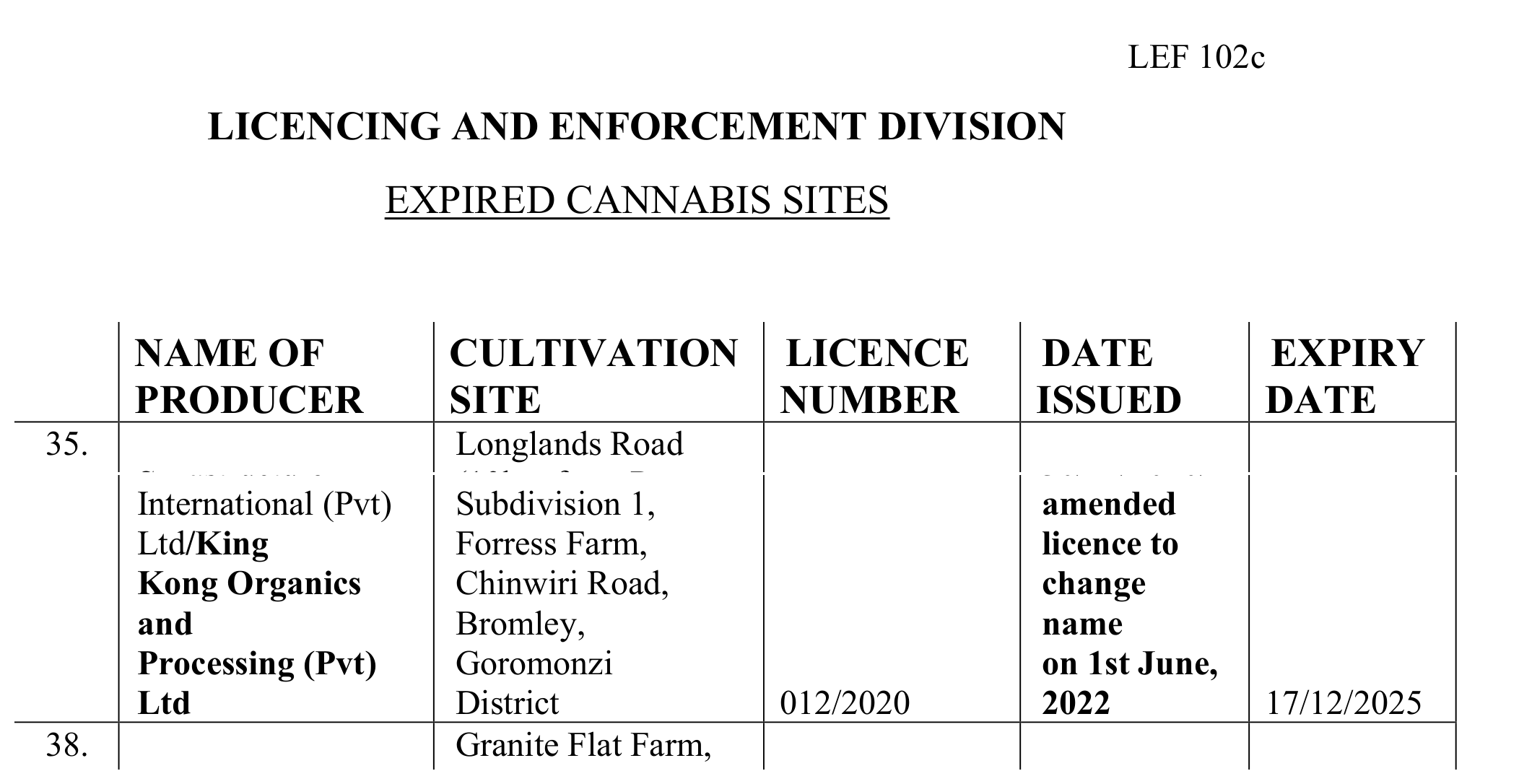
Zimbabwe. The Medicines Control Authority of Zimbabwe publishes two registers: one of active cannabis licences and one of expired ones. In the register of expired licences, revised in January 2026, entry 37 is Structured Infrastructure International (Pvt) Ltd / King Kong Organics and Processing (Pvt) Ltd, Forress Farm in Goromonzi District, licence 012/2020. Neither the company name, the farm nor the licence number appears in the register of active licences, which runs to twenty entries.
The same row also shows how the King Kong name got there. The licence was issued on 30 December 2020 and was subsequently amended to change the name on 1 June 2022. The name was therefore added to an existing licence twelve weeks before the California regulator issued its order.
Malawi. In its 2021 licensing round the Cannabis Regulatory Authority published the names of 35 companies and cooperatives granted 86 licences in total. KKOG is not among them. The authority keeps no public register of licence holders, and later rounds have not been published in the same way. The claim of a licence issued in August 2024 can therefore neither be confirmed nor disproved against a public source. Svenskhampa has requested a licence number or a copy.
The Democratic Republic of the Congo. The claim cannot be checked. The country keeps no public register of cannabis licences. How permits are issued is, however, apparent from a document KKOG itself attached to its reply: by ministerial order in each individual case. That document concerns a different company, and is dealt with below. Svenskhampa has requested the licence number and issuing authority for KKOG's own Congolese licence. The question is unanswered.
Rwanda requires a distinction. Cannabis is governed by Ministerial Order n° 003/MoH/2021, and cultivation is licensed by RICA, in two stages, where the final licence requires inspection of a completed facility. The licence reported in the press came, according to those reports, from RDB, which is Rwanda's investment promotion body and not a regulator.
South Africa cannot be checked against a register. SAHPRA publishes no list of licence holders, only aggregate statistics. The claim can therefore neither be confirmed nor disproved.
Ten thousand hectares, in two different places
In the CNBC Africa segment of 20 January 2026, 10,000 hectares is given as a single hemp project in South Africa.
On kkog.global the same number, 10,000+, is given as the company's total area under cultivation across all countries. The same page also describes the South African operation as a 1,000-hectare farm in KwaZulu-Natal, an order of magnitude smaller.
Asked which applies, Joseph replies that the KwaZulu-Natal project covers 1,000 hectares, and that 10,000 hectares or more is what biofuel projects of the kind the company is planning in three African countries typically require. The counter on the website, giving 10,000+ hectares as the group's area under cultivation today, remains unchanged.
Two of the four offerings named in the 2022 order were called Zimbabwe and South Africa. They are the same two countries the site today gives as holding an active licence, one contradicted by a public register, the other impossible to test against anything.
Response
Svenskhampa put all of the above to Edouard Joseph in writing. He replied on 30 July 2026, within the deadline and on the substance, signing for KKOG Global SA. Svenskhampa then put six follow-up questions; answers to those arrived on 31 July 2026 from the company's contact address, with Joseph's answers given in the third person. The first reply asks that any publication reflect both the answers and the limitations he sets out. Both replies are set out below.
What he confirms. That the order exists. That the units were called bricks, that they were sold in four offerings, and that buyers were promised monthly dividends. That the KwaZulu-Natal operation covers 1,000 hectares. That the company holds, on its own account, a Malawi licence issued in August 2024.
What he disputes. The finding that investors could not get out. According to the reply, the bulk of the capital was refunded within approximately 30 days through what he describes as "our Swiss partner". The partner is not named and no documentation has been provided. The text of the order stands unchanged: the regulator found that investors repeatedly requested refunds without success.
Two written corrections. On Rwanda he replies that "the relevant process with RICA is currently being finalized". kkog.global still states Active License for Rwanda. On the capacity figure given on CNBC Africa he replies that it is "approximately 5,000 kilograms per hectare, not tonnes".
How he describes the order. The reply states that "the U.S. Securities and Exchange Commission was actively evaluating" certain digital asset offerings, and that KKOG was among a number of entities that received "regulatory correspondence". The order was issued by the California Department of Financial Protection and Innovation, a state regulator. The words Securities and Exchange Commission do not appear in it. Nor do the words digital, crypto, token or coin. The order concerns investment contracts, units in cannabis businesses, and is directed at named respondents.
The attachment. Attached to the reply is a licence document said to show that other operators in the Democratic Republic of the Congo have received only permission to explore the possibilities, unlike KKOG. The document is a ministerial order issued in Kinshasa on 16 March 2024, signed by the Minister of Health, granting the company Mt. Zion Medecinal Botanicals the right to cultivate, produce, hold, commercialise, process and export cannabis for five years. No wording about exploring the possibilities appears in it. It concerns a company other than KKOG. The scan was supplied by KKOG and has not been independently verified against a Congolese source.
Unanswered. Three questions were left unanswered: whether any regulatory or court proceedings followed the 2022 order, which authority issued KKOG's own licence in the Democratic Republic of the Congo, and whether the South African operation rests on a SAHPRA licence or on a project registration.
His reservations, as stated. The reply states that parts of the business are covered by confidentiality undertakings that prevent him from releasing documents, and that the absence of publicly available information is not the same as the absence of a licence. The letter also asks whether Svenskhampa is examining other African operators or KKOG alone, and reserves the company's rights in respect of any publication it considers misleading.
The follow-up questions and the answers to them. Joseph invited follow-up questions in his reply. Svenskhampa put six on 30 July 2026: the licence number and holder for the Zimbabwean licence that does not appear in the active register, a licence number or copy for Malawi, which authority issued the licence in the Democratic Republic of the Congo and a copy of it, the name of the Swiss partner together with the amount refunded and the number of investors concerned, whether Active License for Rwanda should be read as a final RICA licence, and which of the figures 10,000 and 1,000 hectares describes the company's current area under cultivation. The answer came the following day.
The three licence questions are declined together, on the ground that not even licensing authorities release information about their licensees: "even the licensing entities do not share clients' licensees' information". Two of the authorities concerned do precisely that. MCAZ in Zimbabwe publishes open registers of both active and expired cannabis licences; Malawi's CRA published the names of all 35 licensees in 2021. The company had moreover itself attached another operator's licence document to its first reply.
On the refunds, the reply states that the matter is "public knowledge (see attached Google Search)". The email contained no attachment. No partner is named, and neither an amount nor a number of affected investors is given.
On Rwanda: "The website is correct as our license in Rwanda; thru Rica is active (whether a Provisional or Final, both are active licenses)." Whether the licence is provisional or final is not stated. The reply further states that KKOG is "partnered with the government of Rwanda" and that no further detail can therefore be shared. The question was put twice; on neither occasion was a final licence confirmed.
On the area under cultivation, the reply states that the company has "multiple 10k ha projects in different stages of development" in three African countries, and that "once it launches, we will gladly share details". The counter on kkog.global, 10,000+ hectares under cultivation, thus refers, on the company's own answer, to projects that have not yet launched.
The reply closes with an invitation not to place too much weight on licences, "try not to get too tied up on licensing, as Africa is not like Sweden", referring to agreements with countries that have not publicly legalised cannabis but which, according to the reply, have issued "Certificates of No Objection" or designated special economic zones where cannabis is cultivated, processed and exported. Svenskhampa has not been able to test those statements. The licence claims examined in this article are the ones the company itself publishes on its website.
Sources
- California DFPI, enforcement action King Kong Organics: dfpi.ca.gov/enforcement_action/king-kong-organics/
- Desist and Refrain Order, 24 August 2022 (PDF): dfpi.ca.gov/wp-content/uploads/sites/337/2022/08/D-R-King-Kong-Organics-Inc.pdf
- MCAZ, register of expired cannabis licences, rev. January 2026 (PDF): mcaz.co.zw/wp-content/uploads/2026/01/LEF-102c-Database-for-Expired-licences.pdf
- MCAZ, register of active cannabis licences (PDF): mcaz.co.zw/wp-content/uploads/2026/01/LEF-102b-Database-for-Active-licences.pdf
- Malawi CRA, 2021 licensing round (Nyasa Times): nyasatimes.com/malawi-cannabis-regulatory-body-issues-86-licences-for-industrial-hemp-cultivation/
- Ministerial Order n° 003/MoH/2021 relating to the Cannabis and Cannabis Products (RwandaLII): rwandalii.org, Ministerial Order 3 of 2021
- RICA/IremboGov, final cannabis cultivation licence, "RICA will conduct a field visit". The page has been removed from irembo.gov.rw; the link goes to the Internet Archive copy of 16 October 2025: archived copy
- RICA/IremboGov, provisional cannabis cultivation licence, archived copy of 5 December 2025: archived copy
- SAHPRA, guidance on section 22C (PDF): sahpra.org.za, General guide to Medicinal Cannabis
- CNBC Africa, "Biofuels reshaping Africa's energy future", 20 January 2026: cnbcafrica.com/media/7768921408260/
- Prade, T. (2011), Industrial hemp, a high-yielding energy crop, SLU Alnarp: pub.epsilon.slu.se/8415/
- Regulation (EU) 2021/2115, art. 4(4): eur-lex.europa.eu/eli/reg/2021/2115/oj
- kkog.global, archived 30 July 2026: web.archive.org/web/20260730133351/https://kkog.global/
- "KKOG Greenhouse Grows", Rene Joseph channel, published 5 November 2018: youtube.com
KKOG's written replies of 30 and 31 July 2026, together with the attached licence document concerning Mt. Zion Medecinal Botanicals, are held in the editorial archive.