Terroir
Everyone is moving south — but the Nordic climate yields more CBDA
Everyone is moving south — but the Nordic climate yields more CBDA
Europe's CBD industry has spent a decade moving south. Longer season, more sun, cheaper land. The logic looks obvious until you read what actually happens inside the plant — and what else comes bundled with growing down there. Sunlight drives cannabinoid production. But sunlight and heat are not the same thing, and Scandinavia has the one without the other.
The industry's map
Look at where Europe's CBD hemp is grown. Italy, Spain, Portugal, the Balkans. Ask why, and the answer comes without hesitation: longer season, more sun, lower cost.
The last two hold. The first — more sun — is more complicated than the industry believes. And nobody has costed what comes with it.
Scandinavia, meanwhile, has been written off. Season too short, too cold, too far north. The argument has never been tested against data, because nobody bothered to collect any.
Sunlight governs — but sunlight is not heat
That light drives cannabinoid production is established. In hemp inflorescences, total CBD rose 36.88% when light intensity was increased, and the researchers could follow the mechanism down to gene expression: the entire biosynthetic pathway from hexanoate to cannabinoids was coordinately upregulated, with a significant increase in CBDAS — the enzyme that builds cannabidiolic acid (Frontiers in Plant Science, 2025).
Genetics determine which cannabinoid the plant makes. That is settled at a single locus with Mendelian inheritance (de Meijer et al., Genetics 2003). But how much is not fixed in the seed — it is settled in the field, and light is the strongest lever.
This is where the industry goes wrong. It read "more sun" as "further south", and treated the heat as a free bonus.
It is not free.
The ceiling nobody costed
Holweg et al. (2025) raised day/night temperature from 25/21 °C to 31/27 °C at full light intensity. For CBD-rich genotypes, total cannabinoid yield fell from over 200 g/m² to under 100 g/m². Inflorescence development was disrupted and biomass declined. Published in Environmental and Experimental Botany 230, 106085 (doi:10.1016/j.envexpbot.2025.106085).
More than a halving. Across six degrees.
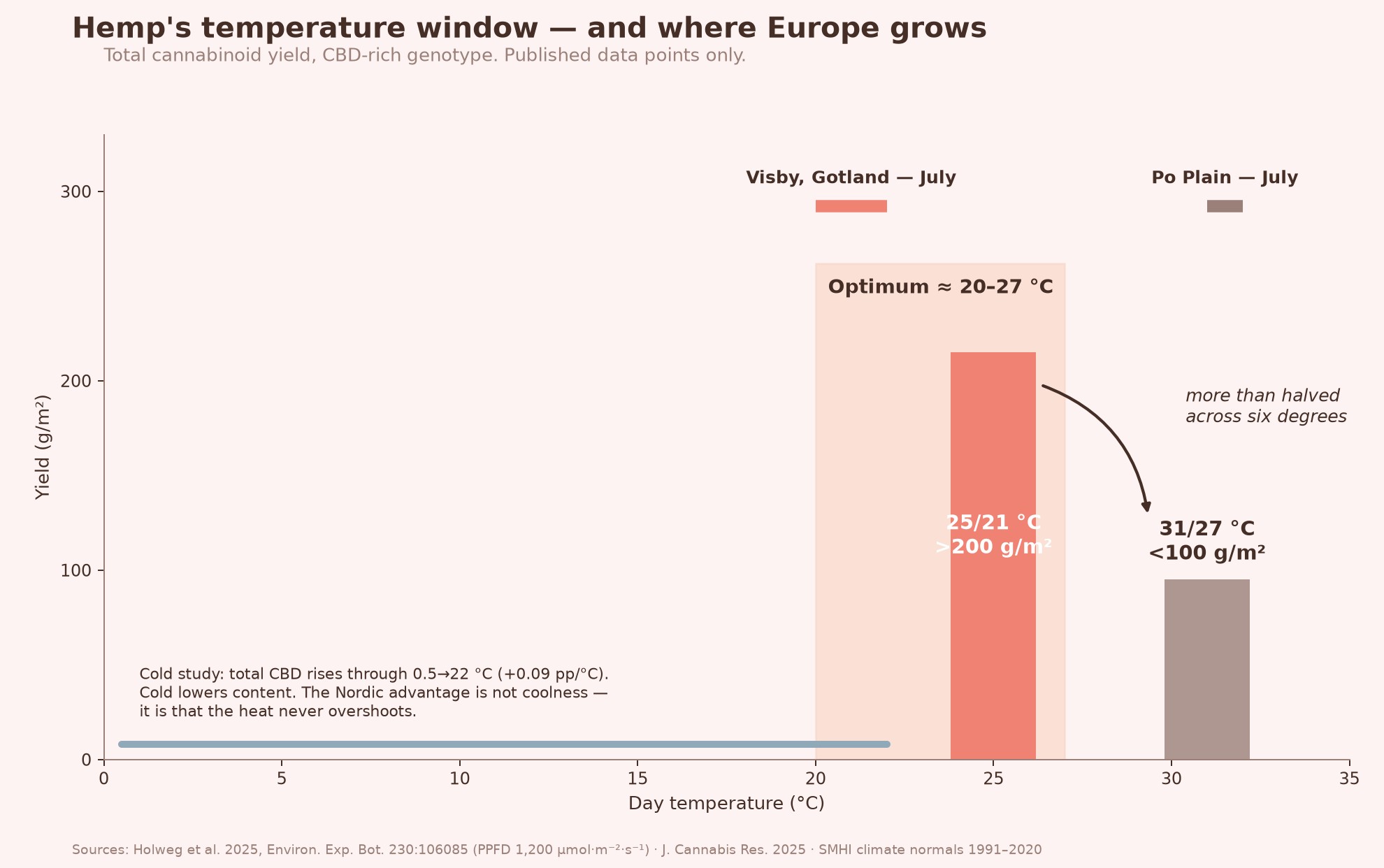
The lower flank is mapped too: total CBD rises across the range 0.5–22 °C, at roughly 0.09 percentage points per degree (J. Cannabis Res. 2025). Cold lowers content. So this is not a claim that cooler is better — it is a claim about a window, roughly 20–27 °C, and about who sits inside it.
Visby in July: about 20–22 °C by day, 13–14 °C at night (SMHI).
The Po Plain in July: 31–32 °C mean maximum, with roughly half of summer days above 30 °C (Climates to Travel).
One sits inside the window. The other sits on Holweg's damaging treatment arm — not as a heatwave, but as a normal year.
What the North actually has
Gotland is Sweden's sunniest region: Visby and Hoburg record just over 2,000 sunshine hours per year as a 1991–2020 normal. At midsummer, daylight runs close to 18 hours.
It is the combination that is unusual, not the individual parts. Long light days and a temperature that never overshoots the ceiling. Southern Europe has the first but pays for it with the second.
Add what a sunshine-hours table does not show: calcareous, free-draining soil; sea wind that keeps the canopy dry and lowers fungal pressure; and a short, intense season in which the plant builds without pausing for heat stress.
No single one of those factors decides it. Together they do.
The bundle that comes with going south
This is usually where the discussion stops. It should not, because there is a third factor the industry never raises: where that south actually is.
According to the European Environment Agency, the Po Plain is the most polluted region in Western Europe. PM2.5 levels are driven in part by ammonia from agriculture itself, and air pollution was linked to more than 50,000 premature deaths in Italy in 2020 (EEA data).
Pesticide intensity follows the same map. France, Italy and Spain use the most per hectare in the EU; Sweden and Denmark are among those using the least (Eurostat).
In fairness: Italy has cut pesticide sales by roughly 43% between 2011 and 2024 — one of the steepest declines in the EU. The direction is right. The starting point was simply high.
Why this weighs more for hemp than for other crops
For most crops the surrounding environment is one quality factor among many. For hemp it is a product specification.
Hemp is a documented accumulator of arsenic, cadmium, lead, mercury, copper, nickel, zinc and PFAS (Ansari et al., Remediation Journal 2026). The same property that makes the plant useful for soil remediation makes a site's actual values decisive for the finished product.
What the market looks like today, read correctly: across 202 commercial CBD products, heavy metals were detected in 44 and pesticides in 30 — but only around 3% exceeded regulatory thresholds. The genuinely striking finding was different: 74% deviated by more than ±10% from their own stated content, and residual solvents were present in 90% of products (Gidal et al., Frontiers in Pharmacology 2024).
The market is not primarily dangerous. It is imprecise. It does not know what it is selling, and it can rarely say where it grew.
The data point
A Swedish comparison points the way everything above predicts. Identical hemp seed grown at two locations, analysed independently by the same method (HPLC-UV):
| Growing location | CBDA (% w/w) |
|---|---|
| Gotland, Sweden | 8.83 |
| Italy | 6.64 |
+33% for the northern-grown material. Published with a DOI under CC BY 4.0 (10.5281/zenodo.21250740).
The comparison has an unusual methodological strength: the cultivar is day-neutral. Autoflowering hemp flowers on an internal clock rather than on daylength — the genetic basis is mapped to the Autoflower2 locus carrying the FT ortholog CsFT1 (Dowling et al., The Plant Journal 2024). The plant therefore ran the same life-cycle length at both sites. Photoperiod — the classic confounder in every latitude comparison — is not adjusted away after the fact; it is engineered out by the plant's own biology.
What this is not
Underdog stories get worse when they are overstated, so:
- It is n=1 per site. A paired observation, not a controlled trial. The published note says so itself.
- The Italian growing location is unknown. The seed supplier protects its customers. The Po Plain is used here as a representative southern European growing environment, not as the reference sample's site. Italy spans ten degrees of latitude.
- The light mechanism has a ceiling. The study above measured 200→600 µmol·m⁻²·s⁻¹. A separate study found concentration unchanged between 600 and 1,000 (Llewellyn et al., Frontiers 2022). Full sun exceeds that level at both sites. Any northern light advantage must therefore act through the length of the day rather than its intensity — and that is not directly tested.
- Holweg was not read in the original. The figures are verified verbatim through a citing peer-reviewed article; the original sits behind a paywall.
- Cultivation data is missing. Radiation sums and canopy temperature are not being logged this year, so the mechanisms cannot be separated on present evidence.
The conclusion
The industry moved south to fetch sunlight, and brought back heat, air pollution and the highest pesticide intensity in the union. It optimised for season length and missed the ceiling.
Scandinavia is an underdog in this industry in a purely quantitative sense — a few hundred hectares against tens of thousands. But the underdog position rests on an assumption that does not survive checking: that further south means better.
Sunlight governs. It simply is not only down there.
What is missing now is not more argument. It is a multi-year field trial with identical day-neutral genetics across several European latitudes, with logged radiation and canopy temperature and a single analytical laboratory. It does not exist in the published literature. With day-neutral cultivars it is easier to run than it has ever been.
Someone should. Preferably someone with no product to sell.